zaterdag 26 november 2022

Season reverb


SeasonalReverb


Well after the summer runaround we redoubled our tracks locally to see what had been slumbering during the covid slowdown and all that, now back in gear... September saw us rediscovering a piece of Ghent we had not known, perchance, on the way away... (see sommerskool gent ri fica on gruzeblogA) while October had us revisit haunts we had sort of neglected of late: Liège... beginning with the colour-clad station...


Daniel Buren at it's most decorative – I must admit it plays OK with the light and such, but it is a far cry from the radical minimal stripe-statement which made his name – but that is nothing new and I already railed against the tendency way back when I was in Paris and even some time before – as with more of our minimal heroes... anyway, we followed a hapahzard circuit of the 'Art au Centre' which as so many of these sequential group effort has it's merits but don't always hit the mark... but it's okay, eve if we missed out on a work related to our presentation at Bukta around the same time... more on that later. We did however manage to see Djos Janssens intervention at the Théàtre de Liège – might have been more if seen with public moving through the doors, but food for thought anyway, more than just a snack, and I even considered if this in/out aspect was part of the concept... considering he likes to reflect his work back at you through the looking-glass, no?


But it was an uncharacteristically balmy day and we enjoyed just the city as it were before heading to our goal at the Drapieres –'impossibles réparations' the third part of Tatiana Bohm's investigation into the re-ravelling of our colonial past... (commented on Bukta-site) returning to the station a last vestige of the once militant bastion of worker's rights – the whole popular area around Guillmains razed, revolution overpainted...


Grand opening at Hornu – the Mac's celebrating it's 20th anniversary, and for the occasion, Denis Ghilen gave his former boss carte blanche... it was Laurent Busine that put the place on the map after all... and also now he managed to give us a sumptuous understated comment on the state of affairs and ourselves... “Les Fabriques du coeur et leur usage” - far from bloated spectacle and pretense, a slice of life collection in a very traditional frame, but so much to take home in consideration and bemusing...

(and with quite a few favorites past and present, so yes, thumbs up)


Back in Uccle at the academy, Domino Thirion again pleased us with a one-day presentation of a grand collection on a model scale, though it was anything than toying with us – rather a maquette of a possible pavilion in which the small and slight gesture figures large, and the tiniest intervention holds great consequence...


Tolmacheff got himself some more space recently – and used the occasion of his anniversary to show it off- before it gets stuck with art – though admittedly he could not refrain from introducing a work or two of his own... refreshingly understated but stated nonetheless – a tie-tied floor-mat as welcome, and a mysterious orfice leading you to believe... well, up to you...


Thought I arrived late at the B.I.O.S. Show in the rue Bara Brussels, but was in fact not – not thus: noght... Annick had a mishap and wasn't coming, so no performance – though everything was ready: similar set-up as in Antwerp, though darker, more lugubrious – it was evening and there were videos, so no surprise, but it did give the whole a different atmosphere than usual, being light and flighty -

since there was no performance to report on I take the opportunity to reproduce here the full text of my verision written for the Antwerp show..


The work of Annick Nölle has always struck me as light, flighty even, free-spirited and ever so positive – that is why I was slightly concerned to find the reference to mourning in this installation... to mourn the loss of something or someone is to view the past – to re-view. Perhaps my view of a happy-go-lucky and permanently positive artist is but a figment of my own imagination... based on past instances in which I had the privilege to work with her – for instance on the A Ripple in the Stuff of the Universe installation, part of the Ramble series at the Felixart museum, and certainly the various “jaarlijks verlof/vacances annuelles” and various interventions during 'Laboratoires Patacyclistes' and group projects like the Cadavre Exquis in the rue de Flandre.

Annick told me: addressing the question of mourning is one way to talk about how we humans deal with ourselves and our environment in this particular society at this specific moment in time. The way we mourn, or rather not mourn, is in my opinion a serious issue we should really start to deal with, for the sake of peace. There´s a lot of unmourned sadness in our society that turns into violence.

In her earlier work, A Ripple in the Stuff of the Universe, Annick Nölle referenced the literature of Mark Twain and subtitled the 'Wild is the Wind' section with a quote: “Light out for the territories”. It represents the wish for an unorganized landscape full of potential, much like the field or cloud of potentialities in quantum field theory – which also emerged at the turn of the (former) century.   

The materials hark back to a time when the gifts of nature still seemed abundant and life was not yet as commercialized as it is today; freedom of thought, factual though it may be, is under strain through all kinds of applications that influence or affect one’s behavior without one even realizing it. 

Becoming more conscious’ is one of the aspects that is presented here in a whirlwind of potentials, in which the evisceration of bowels – against the wind – becomes a way to reference not only the microbiome yet also that which we all refer to as 'gut feeling'...

The smock from the invitation and performance reminds one of the painters of yore, and its length is reminiscent of the work of Gabriele Münter (not only as a painter, but mainly the anthropologically interesting photographs she made during her visit to the American Midwest at the turn of the (former) century) - who, together with Kandinsky, breached the barrier of abstraction in Western culture back in 1911... heady times which are reflected here: the various grounds, both earth-colored and translucent, populated by any number of representational, fragmentary and abstracted thoughts – put to paper and cut, pasted, arranged and juxtaposed again through repeated manipulation – that pertain to personal reflections as well as notions of NonViolentCommunication, seeking connection so as to facilitate new solutions to old problems... much as for instance Max Plank would think outside of the box to address problems not solved by classic means.


Annick Nölle's work keeps changing yet always retains a connection with earlier incarnations. It is precisely when one thinks one understands it that the surprise strikes, and nothing appears to be in place; it either swirls around in a cloud of potentialities (see above) or lingers for a moment, as it does in a dérive or déjeuner sur l'herbe, with all the elements seemingly disorganised and scattered across the bedspread on the floor or in the air, and the snacks and delicacies mixed in with tracts and essays, heartfelt sentiments and heartfelt laughter. An inspiring conversation of signs and ideas that, at a moment's notice, makes one's head spin so that one might require a moment's rest, one in which one can still perceive the gentle sloshing of digestion.


Het werk van Annick Nölle heb ik altijd licht, vluchtig zelfs, vrijgevochten en altijd zo positief gevonden - daarom was ik enigszins bezorgd om de verwijzing naar rouw in deze installatie... om te rouwen om het verlies van iets of iemand is om het verleden te bekijken – te reviseren. Misschien is mijn kijk op de gelukkige en permanent positieve artiest slechts een verzinsel van mijn eigen verbeelding ... gebaseerd op eerdere gevallen waarin ik het voorrecht had om met haar te werken - bijvoorbeeld aan de de installatie A Ripple in the Stuff of the Universe, onderdeel van de reeks Ramble in het Felixart museum, en zeker de verschillende "jaarlijks verlof/vacances annuelles" en diverse interventies tijdens 'Laboratoires Patacyclistes' en groepsprojecten zoals het Cadavre Exquis in de rue de Flandre.

Annick zei me: het aanpakken van de kwestie van rouw is een manier om te praten over hoe wij mensen op dit specifieke moment omgaan met onszelf en onze omgeving in deze specifieke samenleving. De manier waarop we rouwen, of liever niet rouwen, is naar mijn mening een serieus probleem waar we echt mee aan de slag moeten gaan, omwille van de vrede. Er is veel niet-gerouwd verdriet in onze samenleving dat overgaat in geweld. In haar eerdere werk, A Ripple in the Stuff of the Universe, verwees Annick Nölle naar de literatuur van Mark Twain en ondertitelde de sectie 'Wild is the Wind' met een citaat: "Light out for the Territoria". Het vertegenwoordigt de wens naar een ongeorganiseerd landschap vol potentieel, net zoals het veld of de wolk van mogelijkheden in de kwantumveldentheorie - die trouwens ook ontstond aan het begin van de (vorige) eeuw. De materialen gaan terug naar een tijd waarin de gaven van de natuur nog overvloedig leken en het leven nog niet zo gecommercialiseerd was als nu; vrijheid van denken, hoe feitelijk ook, staat onder druk door allerlei toepassingen die iemands gedrag beïnvloeden of zelfs beïnvloeden zonder dat men het zich realiseert. 'Bewuster worden' is een van de aspecten die hier wordt gepresenteerd in een wervelwind van potentiëlen, waarbij het uitknippen van darmen - tegen de wind in - een manier is om niet alleen naar het microbioom te verwijzen, maar ook naar dat wat we allemaal 'onderbuikgevoel' noemen...

De kiel (Schilderskleed) van de uitnodiging en performance doet denken aan de schilders van weleer, en de lengte doet denken aan het werk van Gabriele Münter (niet alleen als schilder, maar vooral de antropologisch interessante foto's die ze maakte tijdens haar bezoek aan het Amerikaanse Midwesten tijdens de (vorige) eeuwwisseling) - die samen met Kandinsky in 1911 de barrière van abstractie in de westerse cultuur doorbrak... onstuimige tijden die hier worden weerspiegeld: de verschillende gronden, zowel aardekleurig als doorschijnend, bevolkt door aantal representatieve, fragmentarische en geabstraheerde gedachten – op papier gezet en geknipt, geplakt, gearrangeerd en weer naast elkaar geplaatst door herhaalde manipulatie – die betrekking hebben op persoonlijke reflecties en noties van geweldloze communicatie, op zoek naar verbinding om nieuwe oplossingen voor oude problemen mogelijk te maken. Net zoals Max Plank bijvoorbeeld buiten de gebaande paden zou denken om problemen aan te pakken die niet met klassieke middelen kunnen worden opgelost.

Het werk van Annick Nölle verandert voortdurend, maar blijft altijd verbonden met eerdere incarnaties. Het is precies wanneer je denkt het te begrijpen dat de verrassing toeslaat, en niets lijkt op zijn plaats; het wervelt ofwel rond in een wolk van mogelijkheden (zie hierboven) of blijft even hangen, zoals in een dérive of dejeuner sur l'herbe, met alle elementen schijnbaar ongeorganiseerd en verspreid over de sprei op de grond of in de lucht , en de hapjes en lekkernijen vermengd met traktaten en essays, oprechte gevoelens en oprecht gelach. Een inspirerend gesprek van tekens en ideeën die in een oogwenk het hoofd doen tollen zodat je even rust nodig hebt, een waarin je nog steeds het zachte klotsen van de spijsvertering kunt waarnemen.


Die Arbeit von Annick Nölle fand ich immer leicht, flüchtig sogar, freigeistig und immer so positiv - deshalb stimmte mir der Bezug zur Trauer in dieser Installation ein wenig besorgt... es handelt um Rückblick, wieder ansehen – revidieren. Vielleicht ist mein Blick auf die glückliche und dauerhaft positive Künstlerin nur eine Erfindung meiner eigenen Fantasie… basierend auf früheren Fällen, in denen ich das Privileg hatte, mit ihr zusammenzuarbeiten – zum Beispiel bei der Installation A Ripple in the Stuff of the Universe, Teil der Ramble-Reihe im Felixart-Museum, und sicherlich die verschiedenen "Jahresurlaub/vacances annuelles" und diversen Interventionen bei den "Laboratoires Patacyclistes" und Gruppenprojekten wie dem Cadavre Exquis in der Rue de Flandre.

Annick sagte mir: Das Thema Trauer anzusprechen ist eine Art, darüber zu sprechen, wie wir Menschen in dieser spezifischen Gesellschaft in dieser besonderen Zeit mit uns selbst und unserer Umwelt interagieren. Die Art und Weise, wie wir trauern oder besser nicht trauern, ist meiner Meinung nach ein ernstes Problem, mit dem wir uns im Interesse des Friedens wirklich auseinandersetzen müssen. In unserer Gesellschaft gibt es viel ungelöste Trauer, die in Gewalt umschlägt. In ihrem früheren Werk A Ripple in the Stuff of the Universe bezog sich Annick Nölle auf die Literatur von Mark Twain und betitelte den Abschnitt „Wild is the Wind“ mit einem Zitat: „Light out for the Territories“. Es repräsentiert den Wunsch nach einer desorganisierten Landschaft voller Potenziale, genau wie das Feld oder die Wolke der Möglichkeiten in der Quantenfeldtheorie – die übrigens auch zu Beginn des (letzten) Jahrhunderts entstanden ist. Die Materialien gehen auf eine Zeit zurück, als die Gaben der Natur noch im Überfluss schienen und das Leben noch nicht so kommerzialisiert war wie heute; Gedankenfreiheit, wenn auch faktisch, wird durch alle möglichen Anwendungen unter druck gesetzt, die das verhalten beeinflussen oder sogar beeinflussen kann, ohne es zu merken. 'Bewusstsein schärfen' ist einer der Aspekte, die hier in einem Wirbelwind von Potenzialen präsentiert werden, bei dem das Ausschneiden von Eingeweide - gegen den Wind - eine Möglichkeit ist, nicht nur auf das Mikrobiom zu verweisen, sondern auch auf das, was wir alle 'Bauchgefühl nennen...

Der Kittel (Malerrobe) der Einladung und Performance erinnert an die Maler vergangener Zeiten, die Länge an Gabriele Münter und ihr Werk (nicht nur als Malerin, sondern vor allem an den anthropologisch interessanten Fotos, die sie bei ihrem Besuch im Mittleren Westen der USA gemacht hat um die (vorherige) Jahrhundertwende) – und die 1911 zusammen mit Kandinsky die Abstraktionsgrenze der westlichen Kultur durchbrach... repräsentative, fragmentarische und abstrahierte Gedanken – auf Papier gebracht und ausgeschnitten, geklebt, arrangiert und durch wiederholte Manipulation wieder zusammengesetzt – mit persönlichen Reflexionen und Vorstellungen von gewaltfreier Kommunikation, auf der Suche nach Verbindungen, um neue Lösungen für alte Probleme zu ermöglichen. So wie zum Beispiel Max Plank über den Tellerrand blicken würde, um Probleme anzugehen, die mit klassischen Mitteln nicht zu lösen sind.

Das Werk von Annick Nölle verändert sich ständig, bleibt aber immer mit früheren Inkarnationen verbunden. Es ist genau dann, wenn man sie glaubt zu verstehen, dass die Überraschung zuschlägt und nichts auf seinem Platz erscheint; es wirbelt entweder in einer Wolke von Möglichkeiten herum (siehe oben) oder verweilt für einen Moment wie in einem Dérive oder Déjeuner sur l'Herbe, wobei alle Elemente scheinbar desorganisiert und auf der Tagesdecke auf dem Boden oder in der Luft verstreut sind, und die Häppchen und Köstlichkeiten vermischten sich mit Traktaten und Essays, herzlichen Gefühlen und herzlichem Lachen. Ein inspirierendes Gespräch von Zeichen und Ideen, die Ihnen im Handumdrehen den Kopf verdrehen lassen, sodass man eine kleine Pause braucht, in der man noch das sanfte Gluksen der Verdauung hören kann.


Le travail d'Annick Nölle m'a toujours semblé léger, volage même, libre d'esprit et toujours aussi positif - c'est pourquoi j'étais un peu inquiet de trouver la référence au deuil dans cette installation... pleurer la perte de quelque chose ou de quelqu'un est de voir le passé – de re-voir, revisiter. Peut-être que ma vision d'une artiste insouciante et positive en permanence n'est que le fruit de ma propre imagination... basée sur des exemples passés dans lesquels j'ai eu le privilège de travailler avec elle - par exemple sur A Ripple in the Stuff of the Universe, installation qui faisait partie de la série Ramble au musée Félixart, et certainement les différentes « jaarlijks verlof/vacances annuelles » et diverses interventions lors des 'Laboratoires Patacyclistes' et des projets collectifs comme le Cadavre Exquis de la rue de Flandre.

Annick m'a dit : aborder la question du deuil est une façon de parler de la façon dont nous, les humains, traitons nous-mêmes et notre environnement dans cette société particulière à ce moment précis. La façon dont nous pleurons, ou plutôt ne pleurons pas, est à mon avis une question sérieuse que nous devrions vraiment commencer à traiter, pour le bien de la paix. Il y a beaucoup de tristesse sans deuil dans notre société qui se transforme en violence. Dans son ouvrage précédent, A Ripple in the Stuff of the Universe, Annick Nölle a fait référence à la littérature de Mark Twain et a sous-titré la section « Wild is the Wind » avec une citation : « Light out for the Territories ». (foutre le camp pour les territoires) Il représente le souhait d'un paysage inorganisé plein de potentiel, un peu comme le champ ou le nuage de potentialités de la théorie quantique des champs - qui a également émergé au tournant du (avant-dernière) siècle. Les matériaux remontent à une époque où les dons de la nature semblaient encore abondants et la vie n'était pas encore aussi commercialisée qu'aujourd'hui; la liberté de pensée, même aussi factuelle soit-elle, est mise à rude épreuve par toutes sortes d'applications qui influencent ou affectent le comportement d'une personne sans même que l'on s'en rende compte. « Devenir plus conscient » est l'un des aspects qui est présenté ici dans un tourbillon de potentiels, dans lequel l'éviscération des intestins - contre le vent - devient un moyen de référencer non seulement au micro-biome mais aussi ce que nous appelons « à l'instinct, viscéral', du ventre »...

La blouse d'artiste de l'invitation et de la performance rappelle celle des peintres d'autrefois, et sa longueur rappelle le travail de Gabriele Münter (non seulement en tant que peintre, mais surtout les photographies anthropologiquement intéressantes qu'elle a réalisées lors de sa visite dans le Midwest américain au tournant du (avant-dernière) siècle) - qui, avec Kandinsky, a franchi la barrière de l'abstraction dans la culture occidentale en 1911... des temps grisants qui se reflètent ici: les différents sols, à la fois terreux et translucides, peuplés de n'importe quel nombre de pensées figuratives, fragmentaires et abstraites – mises sur papier et coupées, collées, arrangées et juxtaposées à nouveau par des manipulations répétées – qui se rapportent à des réflexions personnelles ainsi qu'à des notions de Communication Non-Violente, cherchant une connexion afin de faciliter de nouvelles solutions à d'anciens problèmes. un peu comme, par exemple, Max Plank sortirait des sentiers battus pour résoudre des problèmes non résolus par des moyens classiques. Le travail d'Annick Nölle ne cesse de changer mais conserve toujours un lien avec des incarnations antérieures. C'est précisément quand on croit le comprendre que la surprise frappe, et rien ne semble être en place ; il tourbillonne dans un nuage de potentialités (voir ci-dessus) ou s'attarde un instant, comme dans une dérive ou un déjeuner sur l'herbe, avec tous les éléments apparemment désorganisés et dispersés sur le couvre-lit sur le sol ou dans les airs , et les collations et les délices mélangés avec des tracts et des essais, des sentiments bien intentionnés et des rires sincères. Une conversation inspirante de signes et d'idées qui, à tout moment, fait tourner la tête au point d'avoir besoin d'un moment de repos, mais où l'on perçoit encore le doux ballottement de la digestion.


dinsdag 2 augustus 2022

fifteen documents and more


As for documenta fifteen, well can't say I saw much...


Empty Friedrichsplatz dead grass


The controversy had already taken it's toll: the head curator threw in the towel, one artist decided to bail, press having more than one field-day... heat wave slowed the teeming masses to a trickle... or so it seemed with the empty Friedrichsplatz scorching in the sun... clock ticking away time resource and meaning... the venues slightly modified in an attempt to pull them into the public space at large – trying to whittle away the difference between art & life – Flux-like as seen before – as have many of the issues touched upon, but presented differently perhaps, less top down Marxist dialectics and more exotic (Indonesian) names for similar concepts, slightly re-appropriated like the 'ekosistem/ecosysteem' - and yes, the lumbung rice barn – premise is that there is a surplus to redistribute horizontally – anyone who travels around Africa or 'global south' can see USAid, EU and UN food sacks reworked as clothes tents and bedding – but that's colonial charity, not what is wanted here... But one can't help comparing the offerings with the many NGOs vying for funds for all sorts of empowering projects worldwide – And while there are quite a few proposals on how to kick start one's own economy, (virtually if not otherwise) most seem content to blame historical wrongs by, well yes, the north/west... 


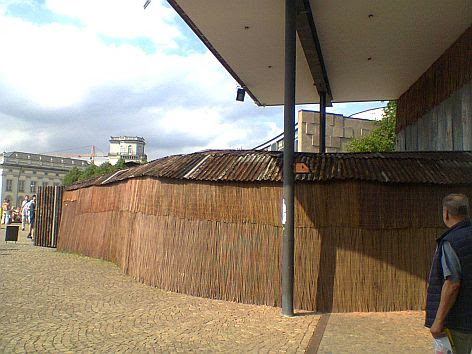
Neue Halle goes south


Archives are a good start, documentation and contextualization – identify where things have gone wrong and correct them... archives, like libraries need stable environments, time to collate and consider, background knowledge to fit into perspective... we are looking at places of study here – call them universities, - ones that process all information, and not just a selection – for that you need freedom, and that is where the tensions emerge – where is what appropriate and when should an expression be subdued?

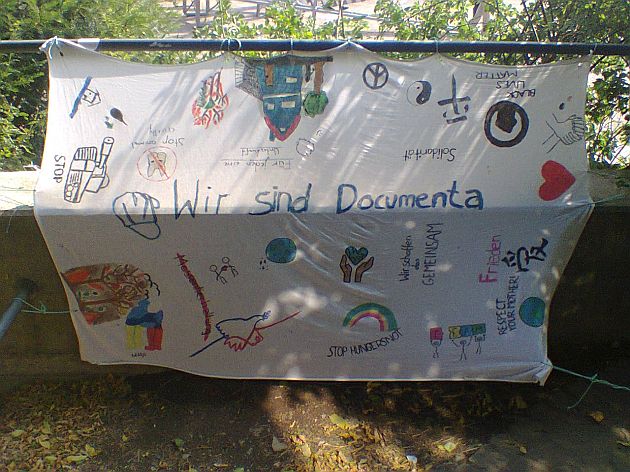
variation on 'wir sind das volk'?

They should have left the controversial work and had a decent discussion about its ramifications instead of taking it down and running off – sort of pulled the plug on the whole affair, which now looks more like an adventure holiday with a bad conscience than a real cultural confrontation... especially in the light of the reemergence of a 'European Theatre of Operations' with the first act 'Donbass' already well under way and grain stuck in ships instead of lumbungs...


wonder what Spoerri thinks of this


Otherwise right down our alley, having been busy with alternative group-run spaces and fringe socio-cultural programs for ever so long- it has a familiar feel to it, but perhaps victim of its own success and not made for this kind of showcase... more preparation might have helped, but then if organized like a real show beside the point again. 


quaint?


vrijdag 15 april 2022

Rear-viewing


Rear-viewing reviews


Being involved in a retrospective presentation with additional collation effort and analysis, I found that there is a general tendency in this field which I welcome... another look at / second take on works by people who never made much of an issue about their 'careers' and such, but who's work and activities are up there with the best – if not even better...

As with icebergs, the main body of a cultural field is below the surface and what can be seen is just a chance corner of the whole – before it turns over and we se another part – in the meantime we tend to forget the submerged and see parts of it only when the turn takes place... short moments indeed and that is why I appreciate even to most flighty glimpse...


The most amicable of these short shows is the presentation of 'Patrice Verhofstadt et ses collectionneurs' initiated by Dominique Thirion and friends at the Maison de Culture Uccle, - a nice selection of work by an artist unknown to the markets but very much appreciated by friends, and, with some effort such as this show, might still gain a place in the subconscious of the art scene – even if this latter is so preoccupied with what is new and fresh it does not have much time for the precursors of todays tendencies...

It is a rather unique moment, with a lot of works not seen for ages being shown, and probably will not be seen again for some time... a gathering of friends as it were – hopefully there can still be a publication of sorts to document the fact, since otherwise it is again only for thoses that were there...


More systematic perhaps is the approach taken by Ronny van de Velde, now engaged more than ever to present his collections and curiosities, away from the big commercial presence he had for so many years – and yes, the one that I prefer is Wout Vercammen, who as an old friend had always been in the wings, but as Nihil impossible to show – until the very end at least, and now again, in various contexts from the good ol days – illustrating not only his talent but positioning of his stance in the ever-important sixties...


Various works to be seen in the InBox-series at the MuHKA, but also Rossaert and around town... the beginning of a major posthumous careeer perhaps, and why not (really fifty-fifty)...


Even more thought out and systematic is the presentation of collections allsorts by Eric Fabre at his Cosmos garage – dating back a bit further but essentially along the same thought-lines; 

Chaosmos, la ligne oublié – inspired by the book by Marc Partouche, bohèmes, avant-garde et art contemporaine de 1830 a nos jours – tracing poetical, scientific and personal lines through the historic, the live and the (nearly-) forgotten – again, an important exercise in these times of quick-fix and superficial associations – these being more tenuous but stronger by wit... 

Written texts and conferences to accompany the viewer, interaction with live-and-kicking artists, a sumptious small gathering that gives you brain a good work out as well as your aesthetic palate.


More to come (until mai 1st)


zaterdag 5 februari 2022

archival sessions (again)

 Been involved with archival sessions again, this time harking back to the fifty-fifty era...


only a few anonymous participants, homage to straatman who could not be there, painting landscapes in Mexico...


(thanks to calosM)

maandag 24 januari 2022

Anniverse l'Art


It's Art's Birthday and I'm on the train to Antwerp
Even though there is no party tonight, we celebrate the falling of a dry sponge into the prehistoric bucket of water some 100 000  and fourty five or so years ago... Remembering too when it was noy yet again such a fad, in between fads as it were, when Dennis Anderson scheduled a AB part at his gallery around the corner, to which I was not specifically invited and which at the time I consdered a ruse of sorts, not really being a party but a staged so'ething or other... Set- piece theatre or installation, performance, happening ( to use a good ol term).. My reticence at the time might have been the basis for a refusal after being asked to host a AB meeting at the Factor 44 years later, proposed by a radio-artist and related to the ERU network of sound pieces, live, international... He was also the brother of one of my colleagues... Afterwards I was somewhet sad we didn't do it after all... But then in hindsight perhaps not...
Because,
Maybe it was due to that refusal that we didn't have to organize a party every year on the 17th, and, given the fact that they found a venue at the Museum, made it possible to be a yearly bash with all kinds of participants far more elaborate than what we might have been able to do...
(they messed up Ghent quite a bit by imposing modern buildings onto the station area, making for a heady mismatch which will wear off soon and become just plain ugly...)


 And
After visiting quite a few of these Art's Birthdays since, I can only say a fe of them seemed worthwhile and in the spirit of Filliou, the others being more of a showcase for young talent type of thing, which is not a problem, but I would have liked more 'cucumbrland' attitudes... And in the end with lockdown and masks and passes and all that it no longer seemed viable... Hence this discreet monday-version...
So
This is a sort of birthday outing, and reverie, dérive, whatever one might consider this small corner of the genial republic to be, etrnally, internally and externally... By way of homage I am considering not getting off at Berchem but to continue to the central station to see on the wall a pram, but also in consideration of the desription given by W.G. seebald in his book 'Austerliz'... Which so it seems is subject to a new dance-theatre production opening soon...
We shall see.
(here my old haunt from library-school days... dampoort)
I should take Seebald to hand again, it trailed off after the period of renovations-reading back in 2009, why I don't quite know... Something came up, and I put it aside with the notion to continue, but then didn't... Still the book never made it back to the shelf, and has been waiting on the 'to do' pile ever since... This is the fitting opportunity, it seems to me...
(see if we pass the small towers, maybe this train goes into the tunnel too ...)

woensdag 29 december 2021

year's end update, sort of


I would have liked to do a positive and upbeat report on the new horizons opened up with the easing of restrictions, but alas, it was short-lived and somewhat dowdy... On the one hand happy to be able to visit museums and such again without too much ado – Covid passes are a relatively minor problem when considering the real havoc the virus has created in many countries not so lucky to have economies able to splurge on large amounts of vaccines for it's populace – but even then people seem unhappy... 


Anyway, the shows that we were able to see were okay, though I must admit I have a tendency to like the more retrospective ones... While the idea of Eurasia at the Antwerp Contemporary museum is not uninteresting, it is not new and presenting a colorful collection of all and nothing does not really give it umpf – sure – there are always interesting finds – but much like the 'wunderkamer' of yore (and which had been discarded for dedicated theme shows) it is just that... wonderment for those who have never seen this or that – while for older generations there is not much added value. One might say the same of the retrospective ICC show, a mix and match of 'déjà-vues” but here quite the contrary happens, reminding and augmenting already known information in a new light and making it even more interesting than it already was...


I enjoyed the retro-view of Marianne Berenhaut, someone I've been watching for a while and always appreciated the downtrodden humor depicted in the objects she collects along the way, to bring them together in an all the more disturbing conversation, avoiding the pathetic but reminding us of the fragility of our so-called cultivation... That she has been 'discovered' in recent years is a very good thing, because otherwise this important artist might have just faded into the musty folds of history (again) and been just an anecdotal footnote perhaps in the gallery of artist-artists... while if fact she was always more than an also-ran... an interesting case in point which I will keep an eye on in the future – see what happens.


At the BPS 22 I was a bit skeptical of the “Penultimate version of reality' by Brognon-Rollin at first – fearing yet another collection of all-sorts which seems to be a la mode nowadays ( ...admittedly I myself had been a great purveyor of such shows in an alternative past but in a museum context I expect more slice) But the fact that it is a selection by a seasoned duo in a sort of retrospective mode rather than a theoretical exercise makes it palpable – intriguing and to a degree pleasant in it's depressiveness, featuring the folly of humanity as comfy cushion. Anything but in fact, making us aware of the thin line to disaster along the edge of every day. Maybe it is because of the disaster unfolding outside that the disturbing presentations seem familiar and cozy as compared with the reality unfolding outside – one which is commented on by Alexis Dekonninck in his 'sleeping on concrete' performance series involving a playful re-use of temporary structures.... for me it is a bit bitter, since I thought the trees that have now been removed in front of the museum were it's best asset.


The fourth mail-art offering (this time Barbery & Stuckens) is interesting but perhaps a bit less than the first three and incorporating quite a bit of similar stuff – which is perhaps also a normal illustration of the phenomenon mail-art, in which authorship and re-distribution tend to favor the most active – which is why: the hard core of the surviving scene are a bunch of people known to each other for quite some time now... but as a reference to various (ether) media (radio, cassettes, records..) and insight to the contemporary social media phenomena it can count – good series, hope to see more diversity in future...

Also passed by the CivA, but there too, so much to see that nothing really stuck even though there were things that attracted the attention, for a bit, but then surpassed/exchanged for the next... the guidelines sort of tell the story – like a switchboard scheme, interesting for those that are looking for a specific glitch.


vrijdag 17 september 2021


Left early


For Paris on the fast train straight from Antwerp to Paris Nord... Arived a bit later than scheduled but early enough to make our first stop a boulangerie and the a grand crème next to Sainte Eustache... From where we proceeded by metro to the Etoile, place Charles De Gaule where they were installing Christo's 'Arc de Triomphe, wrapped' -finally after years of asking, pleading, wrangling... (project first proposed in 1962' which makes it apt to this research...) and reminding me of Jiorno's comment that " the best thing an artist can do for his career is to die.."


But we leave that to one side for the moment and reconsider the reason for going in the first place... Jef Lambrecht's video of the reichstag-wrapping - I also appreciate Christo's work, beginning with Valley Curtain, and later also the smaller works that probably inspired Jef to package various works, often including found packages of Peter Stuyvesant cigarettes as part of the recurring series of processes concerning his fight with the tobacco giant. He also used packaging methods in his performances, resulting sometimes in more-or-less permanent sculptures, but more often than not short-lived statements... (often making use of furniture without asking the owner's consent, and after the exhibition they would be returned to regular duty as chair...)


Former BIWA co-director Karel told me about how Jef was adament about going to Paris the meet Christo during his wrapping of the Pont Neuf - he wanted to make some sort of BIWA combination-piece or conversation piece, but there was no funding and it is unclear if Jef went to Paris at the time on his own, since Karel was not willing to pay for his own travel and expenses... So far I have not found any specific reference to the Pont Neuf project. (but pretty certain he went anyway...)


A very different story is the wrapping of the Reichstag in Berlin. By this time BIWA as such no longer existed and so it was an independent effort, but still related to BIWA Ear or Earth, as far as I can remember.. ( will have to check to ascertain if he still used the BIWA label for his presentation..)

Jef filmed the wrapping process with his own handycam, even though he was there in an official capacity for the state radio ( I think) he made his own reportage entitled "Reichstag im Negligé" which he presented at the AK-37 in 1995....(video will be run as soon as digitized)


I had planned to show this video as an opener at the archive presentation in his home town Avelgem because the hosts were also into Christo and had some works of his on display... Why not use this coincidence... Then, when it became clear that the Arc de Triomphe project was going to be ahead and the video of the Berlin project would not be ready I thought I would shoot a sequel as a sort of homage...


Emerging from the metro it was already quite a sight... The silvery cloth had already been draped and for the most part already closed, except for some corners and details and fiddly bits... Much like the situation that Jef encountered in Berlin. ( a bit earlier, with some banners still being let down the façade...) The light too was similar, it had just rained and the sky was lightening up but had a similar hue and intensity as the drapery, making for a ghostly and sometimes difficult to discern silhouette... Again much like Jef had encountered in Berlin...


I found it was not that easy to get good shots but the visuals were intriguing, and by doing it myself could understand more fully the reasons for the slowness of Jef's video... The work of Christo sort of forced one to slow down... I was watching one person filming the activities through the reflection in a puddle left behind from the rain... Many passers-by, on foot motorcycle or car would pull over to take some pictures... Some viewers were obviously there specifically for the theatre being presented, and there were even some ushers provided... They were wearing plastic capes and could easily be included in the wrapping process...


Just as with Jef's video the workers were installing the drapes by means of absailing and cranes, ropes and dangling bits here and there making for an interesting variation in activities, while I myself changed position, going around the Etoile section by section, and so having a complete 360 degree roundabout view, with a shot from the middle of the Champs d!Elysees as anchorpoint. The sun came out for a bit, enhancing the contrast and making the piece nearly luminous... I decided to return in the afternoon if there was a chance of direct and low sunlight, which I imagine would be quite spectacular.


The lanterns were also a feature which I found important... Jef concentrated quite a few of his shots and still photographs on the Lanterns surrounding the Reichstag, and here too there were lanterns perfectly placed to be incorporated in the shots. There were old style and more modern lanterns, as well as broken and damaged ones which all had a useful function in the process of recording the situation.


( so perhaps I will use one of these images for a copycat Lanterne de Lantin, being Bombyx Mori, as homage and information carrier... See if I might still have a Reichstag LdL somewhere... Preferably an original sent from Berlin)


Of course used the opportunity to enjoy Paris, given that the rain had stopped and there was intermittent cloud, some rays of sun... Very agreeable weather to do some rambling around, lunching on quiche in a park in the Marée, visiting the construction site of poor Notre Dame, a sorry affair... And a visit to the newly refurbished Samaritaine... Gleaming but not what it used to be... At the Palais de Justice large security force, streets blocked for the terror trial: the perpetrators of the Bataclan massacre... Noticed in the subway older men just standing in the corridors holding up one finger... 'There is but one...' - Taliban grandfathers admonishing modernised Muslims to revert to archaic teaching... I fear France has not seen the back of Islamic radicalism just yet, perhaps it's only the beginning, seen as how the historic centre is surrounded by banlieues...


Dark clouds accompanied our train as it slid out of the Gare du Nord in the evening, but it had been a bright and agreeable day, and I was glad that I decided to go through with the undertaking, being just in time before the negligée was buttoned up completely... Now the official presentation can commence, and we will see if the 'desnudance' might be worth another trip...